This page contains some of the resources that I mentioned in the workshop at Leipzig Contact Improvisation Festival 2025.
The workshop is inspired by Brian Massumi’s new book The Personality of Power A Theory of Fascism for Anti-fascist Life (2025), and accompanying book Toward a Theory of Fascism for Anti-Fascist Life.
This book introduced me to a new lens to investigate Fascism as an affective regime of reaction that agitates and orients bodies at the molecular (cellular level) or pre‑cognitive level. Through dance, somatic and embodiment practices, we have the potential to practice a way of life that is anti-fascism.
Brain also questions the notion of the “person” as a stable, autonomous individual but formed in a collective process, in which multiple persons can share joint possession of affective fields.


In Brian’s writing, Fascism is not just a historical event, nor a regime – it is a recurring process, adapting and re-emerging in new forms. How can we understand power, personality and collectivity? How do we trace the way fascism operates, spreads, and takes root in the collective psyche?
Classical framework to understand fascism is centred around one “mass” movement, one charismatic “leader”and a certain ideology. Brain inspires us to understand it through “personality of power”, relations, affective fields (bodily, pre-cognitive intensities, pre-emotion) and micro-bodies; Ideology is replaced by impulses and reactions, what Brian calls an “affective regime of reaction” that agitates and orients bodies at a “molecular level”.
I have been exploring through scores on many concept proposed by this book, especially on cellular level how affect and reaction works, how power makes persons, moves through persons, and links them affectively.
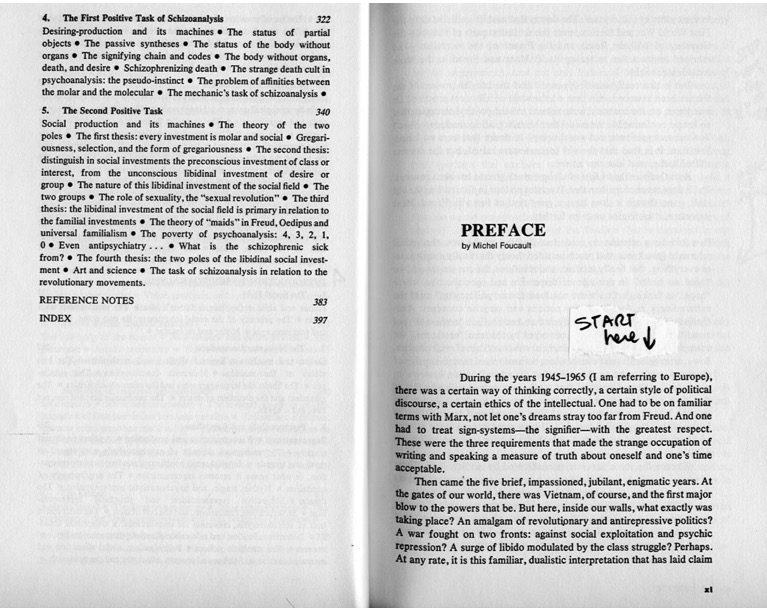
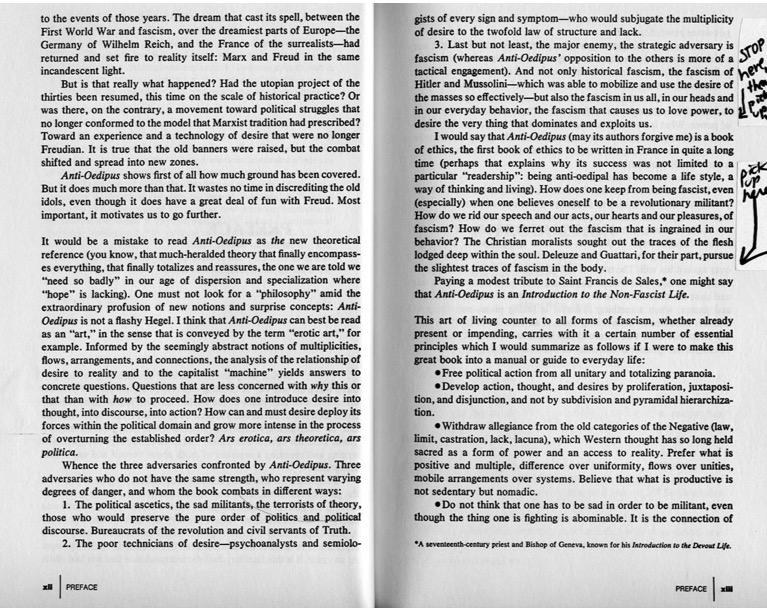
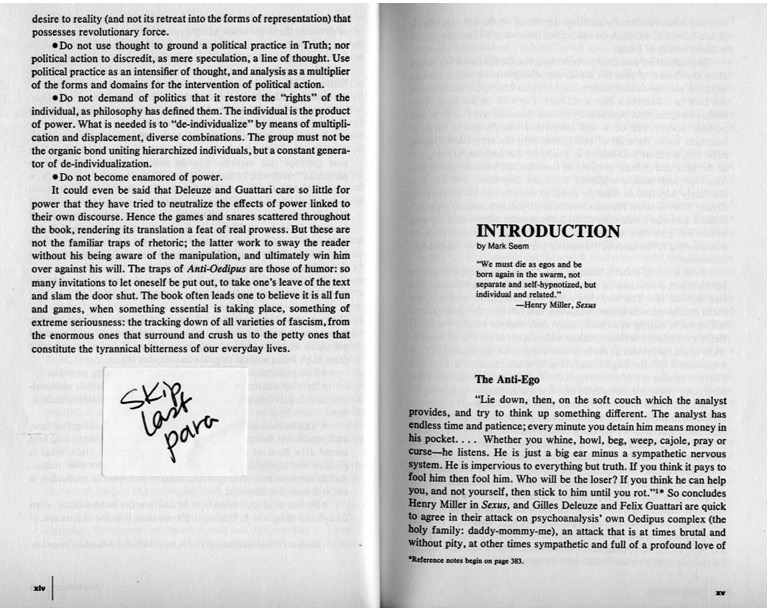
I am also referring the original idea of non-fascism way of life, from Michel Foucault’s Preface to Anti-Oedipus. This book by Gilles Deleuze and Félix Guattari is the first volume of a larger book titled Capitalism and Schizophrenia. Anti-Oedipus is published in 1972, exactly the same year of the birth of Contact Improvisation. You can read a photocopy of this short essay by Foucault below, or move with the audio.
The three points that I summarised at the workshop are:
- Practice thinking and living in multiplicity.
- See desire as a generating force, not as lack.
- Don’t fall in love with power, even the smallest of it.
The state is a condition, a certain relationship between human beings, a mode of behaviour, we destroy it by contracting other relationships, by behaving differently towards one another. We are the state and we shall continue to be the state until we created the institutions that form a real community.
_Gustave Landauer
Here are some of the questions I ask in my own practice:
What do I do? What do I perceive? What do I take as truth *wahrnehmung? Mindfulness/awareness as anti-fascism practice at cellular level.
Micro-fascism takes shape on molecular level, in our everyday habits, desires and relations.
Dance improvisation as a practice of non-fascist living.
Fascist seeks order, obedience and uniformity, improvisation thrive to openness, plurality and relation. Fascist invite standardised protocol, improvisation invite change.
Practice thinking and living in multiplicity.
How can we be one and many simultaneously? How do we practice against binaries and totalities? How do we listen, improvise, co-existing without domination? How do we affirm different (be welcomed by different rather than welcome difference)?
See desire as a force of production, not as lack.
Sense of lack generates scarcity and competition, and thinkings such as not achieving enough, not good enough, not well-planned enough, incomplete. Rather we can see desire as a generative, active, productive force, it creates connection, assemblages and new realities.
Don’t fall in love with power, even the smallest of it.
Who speaks, who decides, who listens, who directs the flow, who is in the centre? How do we share knowledge with each other without monopolize? How can we de-certificate/de-trademark embodied knowledge and our practice? How do we build collective structure (think of tensegrity, rhizome) instead of pyramid of authority? How do we create space?
Three things to bear in mind while we practice: we are here to do the impossible (from bodhisattva way of living), we fall all the time (from contact improvisation), use everything and start again and again(from Gertrude Stein).
More work around the topic within Contact Improvisation community:
writings by Heike Pourian, you can check out her books at https://beruehrbarewelt.de/#slide4
mayfield brooks’s work Improvising While Black, http://wrongcontact.zone/notices/improvising-while-black
Finally, a talk by Keith Hennessy to Freiburg Contact Festival 2025:
Thanks to Leipzig Contact Festival for us to gather, dance and exchange. For me, teaching is a practice too. I am happy to hear your feedbacks and further thinking/practicing. Please get in touch at haolongyin@gmail.com
And here is a telegram group for updates and future labs around this topic https://t.me/+3YnuHf6UjCU0MTQ1